
Frog
“There are two kinds of pets—the ones you choose and the ones that happen to you,” writes Anne Fadiman.

Each Saturday, Harper’s Magazine editors will share a free reprinting of a piece. To gain access to our fully digitized archive, subscribe today. “Frog,” which was published in Harper’s in March 2023, is the title essay from Fadiman’s essay collection, out this month from Farrar, Straus and Giroux.
Frog
What happens to the pets that happen to you
By Anne Fadiman
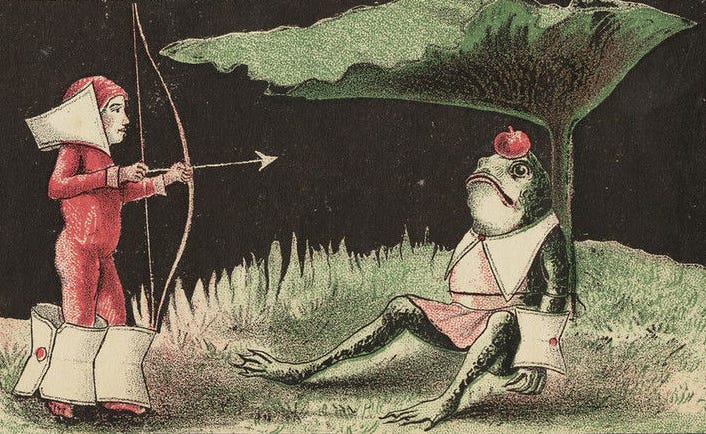
Until last summer, we had a dead frog in our freezer. When Bunky died, George and I thought we should wait to bury him till both our grown children were home, so we put him in a Ziploc bag and propped him on his side on a shallow shelf in the freezer door, just above the icemaker. Bunky was flat and compact and, very soon, as rigid as a cell phone. He fit perfectly. I’d always wondered what KitchenAid intended that shelf for—it was too narrow for any food I could think of—but now we knew. It was intended to hold a frog.
There are two kinds of pets—the ones you choose and the ones that happen to you. Bunky belonged to the second category. He entered our family in the haphazard fashion of pets of that ilk: tadpole kit (cubical plastic “habitat” with domed top, like nave of Hagia Sophia, sans tadpole but accompanied by redeemable coupon), left by educational-toy-oriented grandmother for granddaughter under Christmas tree; kit sidelined for years on toy shelf; kit discovered by granddaughter’s preschool-age little brother; tadpole coveted; tadpole coupon redeemed by parents; tadpole shipped to New York City from Florida in Styrofoam container; tadpole universally admired for transparent skin (visibly beating heart!) and awesome metamorphosis (weird whiskers! hind legs! front legs! no more tail!); froglet admired somewhat less; adult frog mostly ignored, except by visiting small boys, who, if they didn’t have frogs themselves, paused to pay brief homage before moving on to Legos, and by owner’s father, who, despite initial intentions to teach son responsibility through pet care, ended up feeding frog (Stage Two Food Nuggets, meted out with tiny yellow Stage Two Food Serving Spoon dainty enough for fairy) and, once frog graduated from Hagia Sophia, cleaning aquarium, first two-gallon plastic, then four-gallon glass (challenging, because frog, coated with gelatinous goo, required apprehension and temporary relocation while aquarium was emptied, refilled, and doctored with dechlorinating crystals, and damn, was he slippery).
Henry, the frog’s owner, says he was convinced for a long time that he named Bunky but is no longer certain.
Susannah, the older sister, says she definitely named Bunky and Henry approved her choice.
George, the frog feeder and aquarium cleaner, says Henry chose a “Bunky-like” name and Susannah fine-tuned it.
I have no idea.
One of the most essential characteristics of pets who enter the family by happenstance is that their lives are brief. Their dependable evanescence makes life easy for parents but hard for children. Our family’s first pet, Bunky’s predecessor, was a goldfish named Rosebell. George won Rosebell by tossing Ping-Pong balls into cups at the St. Anthony’s Church street fair, held each summer a block from our apartment building. Susannah, age four, triumphantly carried Rosebell home in a plastic bag, named her, painted her portrait, and, when Rosebell died three days later, cried so hard she had to take the morning off from camp.
But Bunky didn’t die. While he was alive and kicking—and he was a prodigious kicker—we referred to him as our “immortal frog.” Seasons passed, though perhaps not from Bunky’s point of view, since he never went outside. A year went by. Five years. Ten. Finally, sixteen.
Actually, maybe seventeen, but I will err on the side of caution because I don’t want to risk even a whiff of amphibian résumé inflation. We all agree that Bunky was at least a year old when we moved from New York to western Massachusetts, his water sloshing noisily in the plastic aquarium (this was the two-gallon phase) wedged between my feet as we drove north on I-91 in our rented minivan. It must have been harrowing for him, like a storm at sea.
On our first night in Massachusetts, after we turned off the lights, I called George’s attention, dreamily, to the bucolic sound of peepers wafting through our window from the riverbank. He informed me that we were listening to Bunky, in Henry’s room, over the baby monitor.
Bunky was an aquatic frog who surfaced only occasionally (he had lungs and breathed air, but not very often), at which time his googly eyes would protrude above the waterline, lending him a faint resemblance to a two-ounce hippopotamus. He had five diaphanously webbed toes on his hind feet, three of them clawed, and four long, thin, sensitive-looking fingers on his forefeet. He looked nothing like Frog in Frog and Toad, or indeed like any of the barrel-chested bright green mesomorphs in our children’s picture books. He was pale. Planar. Ghostly. More than a little Gollum-like.
Because he wasn’t built for life on land, Bunky lacked the sine qua non of frogdom: the ability to jump. He was like a bird that couldn’t fly, a snake that couldn’t slither. However, he compensated for his terrestrial shortcomings with his grace in the water. Sometimes he lay splayed on the bottom, like a rug; sometimes he floated, unmoving, at a forty-five-degree angle. But when he took off, he was so efficient as to seem positively urtextual. He could swim up, down, forward, backward, and sideways. The in-and-out whoosh of his hind limbs—akimbo, straight, akimbo, straight—could have been the pattern on which all frog kicks were based, his powerful webbed feet the model for all swim fins.
You may be wondering: What kind of frog was he?
I didn’t.
By both habit and temperament, I am drawn to research like a frog to a Stage Two Nugget, but I never researched Bunky. I didn’t know what species he was until he was nearly ten. A student I’d hired to help me with office work walked past Bunky’s aquarium and said, matter-of-factly, “Oh, you have a Grow-a-Frog.”
A what?
That, of course, was just Bunky’s brand, which I had long since forgotten. A little googling revealed that Grow-a-Frogs were African clawed frogs (Xenopus laevis). We’d always thought that because Bunky looked so odd—as if a regular frog had been bleached and then put in a panini press—he had been specially bred in some kind of Frankensteinian laboratory. It was mind-blowing to learn that he had wild cousins frog-kicking around the wetlands of sub-Saharan Africa.
In one fell swoop, we also learned his gender. We had always honored Henry’s assumption that Bunky was male, just as we’d honored Susannah’s assumption that Rosebell was female. But now we had evidence. At night, Bunky sometimes emitted a two-syllable ribbit, a sort of creaky hee-haw: the sound we’d heard over the baby monitor. We read that only male African clawed frogs made this sound, and that it was a mating call.
I often wrote late into the night. Bunky shared my circadian rhythm. For years—ever since Bunky’s aquarium had migrated from Henry’s room to the kitchen counter—I’d been going downstairs for a snack at 2 am, and there he’d been, softly calling for a mate he would never meet.
How could I have been so incurious?
Before writing this essay, I finally learned a few things about African clawed frogs.
They have no tongues, no teeth, and no eyelids.
Their owners have fed them crickets, cockroaches, earthworms, mealworms, bloodworms, slugs, and wood lice, which they shove down their throats with their fingers because of the no-tongue thing. (I’ve watched a video. It’s pretty cute.) Bunky would probably have loved to eat a wood louse. It never occurred to us to feed him anything but Stage Two Nuggets. That’s what the instructions told us to do, the way you’re supposed to use Swingline staples with your Swingline stapler. Which, obediently, I always did.
In 1930, the basis for the first widely used pregnancy test was established when a zoologist in a South African laboratory discovered that female African clawed frogs laid eggs when injected with ox hormones similar to those present in the urine of pregnant women.
In 1962, the African clawed frog became the first cloned vertebrate. The British biologist who conducted the experiment was knighted and awarded a Nobel Prize.
In 1992, four female African clawed frogs flew on the space shuttle Endeavor so scientists could study whether reproduction was possible in zero gravity. A supply of male frog testes was on board. Astronauts crushed the testes and used the sperm to fertilize eggs obtained from the female frogs. Tadpoles resulted. “We don’t see any reason to suspect that fetal development could not be accomplished normally in the absence of gravity,” said a NASA scientist. “That includes humans.”
I realize that a psychiatrist might say this essay is an attempt to atone for my lack of interest in Bunky when he was alive. A lot of good that does him now.
We pay more attention to pets that pay more attention to us—the smart, warm-blooded, furry kind that fortify our egos, communicate with us, ease our loneliness, jump onto our laps while we watch TV.
Over the years, our family acquired several pets of that kind, and we lavished time and money and love on them. Chosen pets. Pettable pets.
Silkie was our starter mammal. Once Susannah had seen a picture of a long-haired “teddy bear” hamster, no other variety would do. Two pet stores mendaciously claimed to have them in stock. At the third pet store, Silkie was selected, after careful inspection, from a handful of legitimate candidates that looked identical to me but not to Susannah. During Silkie’s tenure in our household, he was frequently held, extravagantly complimented, and housed in a twin set of terraria connected by an ever-ramifying system of bendable plastic tubes and kitted out with an exercise wheel and a lookout tower.
Biscuit and Bean followed. Bunky’s removal from Henry’s room to the kitchen was a tacit acknowledgment that Bunky had lost his original luster and was no longer really “Henry’s pet.” Henry was obviously in need of an upgrade: a guinea pig. Biscuit was the most beautiful guinea pig at the pet store. Two days later, Henry decided Biscuit was lonely and begged us to drive back to the store and reunite the family by bringing home Biscuit’s brother, Bean. This time, Henry thought up the names all by himself, and contributed a decent amount to the feeding and cleaning detail. Henry and I built a bi-level habitat out of closet modules about six feet long and three feet wide, with a carpeted ramp leading to the second floor, and furnished it with Quonset-hut-shaped sisal hideaways. In warm weather, when we ate outside, we set up a giant pen on the lawn so Biscuit and Bean could graze on grass, like Swiss cows in their alpine summer pasture.
A couple of years after Silkie’s death, Susannah convinced us she was ready for the big leagues: a dog. Although she was allergic to most dog hair, a campaign of experimental sniffing established that she was not allergic to dachshunds. Her allergies would eventually abate, enabling her, many years later, to adopt two rescue dogs of heterogeneous ancestry, but Typo came from a purebred litter of long-haired dachshund brothers I had zeroed in on after months of googling and phoning. Following the instructions in an article I’d read on how to evaluate dog temperaments, Susannah dutifully banged a pot with a metal spoon to assess sound sensitivity and dragged a towel across the ground to assess curiosity. Though these exercises merely perplexed the puppies, one of them confidently identified himself as the winning candidate by walking straight toward her.
Susannah accompanied Typo to puppy kindergarten and devoted dozens of hours to sit, stay, and come practice. She called him Typo because she had read that dogs respond best to names ending with long vowels (Toto, Fido, Lassie, Snoopy), and, like her parents, she was a compulsive proofreader—though she assured her friends that nothing about Typo was a mistake. Over time, he also accreted a sizable collection of nicknames, including Mr. T, Mr. Guy, Mr. Fellow, Mr. Sweetpie, Monsieur le Rinpoche, Best Dog, Favorite Dog, Nicest Dog, Rumischnaug, Naug-Naug, the Typositor, and Sir.
While Bunky was drifting around his aquarium, largely overlooked, Typo was knocking all our socks off. Our infatuation never flagged. He was the softest dog we’d ever petted, and when he galloped his gait looked like a sine wave, and it took him only twenty minutes to learn how to use the newly installed dog door that led to a spacious fenced yard of which he could avail himself whenever he wished, and he once walked eight miles with George (which, by leg-length ratio, we calculated was the equivalent of ninety-six George miles), and whenever we returned from the supermarket he greeted us with the romantic ecstasy of a soldier reuniting with his lover in the final moments of a World War II movie, and . . . well, you get the idea. I could have written ten thousand pages about Typo. Instead, I sang him songs. I didn’t exactly make them up; they crept into my head, unbidden, before I had a chance to apply even the most rudimentary literary or musical standards. For example:
Typo, Typo, you are a dog!
I’m so glad you’re not a frog
It’s not that we don’t love Bunky
But you are so much more hunky
Typo, Typo, Typo, you’re a dog!
But actually, we didn’t love Bunky.
Bunky was the anti-Typo. An unpettable pet. Cool to the touch. Squishy, but not soft. Undeniably slimy. Impervious to education. A poor hiking companion. Not much of a companion at all, really. Couldn’t be taken out of his aquarium and placed on a lap. Never learned his own name. Never came when called. Never sat. Never stayed. Never snuggled. Never greeted us at the door. Lived in water that, according to George, smelled like poop. Ate food that, according to Henry, smelled like feet.
Some people love their African clawed frogs.
The proprietor of Karen’s Frog Page was once so worried when her frog had a lump in her belly that she took her to the vet for an X-ray. She had swallowed sand.
Maurice the Grow-a-Frog has his own Facebook page, with 820 followers, on which his birthday was celebrated annually until his passing in 2016. The next year, on what would have been his twenty-eighth birthday, his owner posted a photograph of him superimposed with colored hearts, stars, diamonds, and the note MISSING YOU TODAY MAURICE.
A member of a British amphibian forum reported an escaped frog: “help!!! how has he vanished in thin air!? if he has miraculously gotten out of his tank—will he survive long? the room is carpeted. Im gutted, he is very much loved.”
Some people loved our African clawed frog. Or at least took more notice of him than I did.
Until he moved away from the neighborhood, Henry’s friend K.C. took care of Bunky when we were on vacation. George once dreamed that Bunky was so happy to see K.C. that he leaped out of the water into K.C.’s hands. In the same dream, K.C. told George that Bunky’s aquarium had tidal currents.
Our friend Carrie, who succeeded K.C. as Bunky’s frogsitter, has told me that at first she thought Bunky was strange; she’d never seen a frog who looked so un-Kermitish. Then she decided he had personality. She likened his swimming to water ballet. Sometimes she sat in front of his aquarium and watched him watching her. She’d run her finger along the glass and he would swim beside it. She called this their “special one-on-one time.”
George remembers early mornings when he, Bunky, and Typo were the only ones awake in the house. He felt that Bunky was being responsive, in his way, when he swam up to feed on the Stage Two Nuggets that rained down from the little yellow spoon, sweeping them toward his mouth with his forefeet in what George thought of as a gesture of enthusiastic welcome, like a friendly minister telling his congregants to come right on in. It would not be an overstatement to describe George’s attitude as fond, even though he disliked touching Bunky, whose skin reminded him of boiled okra, and hated cleaning his aquarium, especially the bridge and the doughnut-shaped castle—polyresin “environmental enrichment products” designed to relieve the boredom of confined frogs—which, even after vigorous scrubbing, retained a thin film of crud. Like Carrie, George believed that taking care of Bunky had grown into caring for Bunky. He also wondered if the relationship might have a tinge of reverse Stockholm syndrome.
I understood. I felt more of a bond with Silkie because I cleaned his plastic labyrinth with a bottle brush while I showered. (One of the core activities of parenthood—though nobody tells you this in advance—is dealing with pet feces.) We all felt a bond with Biscuit and Bean, and a far greater one with Typo. There’s a direct relationship between how much trouble pets are and how much you value them. That may be one reason why parents love their children: they are vessels of infinite depth into which effort is ceaselessly poured.
